Imagine managing a chronic condition by taking just one pill every morning instead of setting reminders throughout the day. Extended-release (ER) tablets have made this reality possible for millions worldwide by providing steady medication release over time.
Today, this technology is used in medications that treat everything from hypertension to diabetes and mental health disorders. They've improved patient compliance, reduced side effects, and enhanced overall treatment efficacy.
But creating these life-changing medications is no simple task. It requires a delicate balance of scientific expertise, cutting-edge technology, and meticulous attention to detail.
Key Takeaways
- Extended release (ER) tablets improve patient compliance and reduce pill burden by providing steady medication release over time.
- Developing ER formulations requires balancing scientific expertise, advanced technology, and meticulous attention to detail.
- Key challenges include achieving the desired release profile, ensuring consistency, matching innovator products, and bridging technical expertise gaps.
- Best practices for success include using pre-formulated systems, robust mixing/blending processes, and leveraging external expertise.
- Regulatory and quality considerations—such as dissolution method development and IVIVC—are essential for robust, compliant ER products.
What Is Extended- Release Formulation?
An extended-release formulation is a pharmaceutical dosage form specifically engineered to deliver a drug at a controlled rate over a prolonged period following administration. These formulations typically employ sophisticated delivery mechanisms such as hydrophilic or hydrophobic matrix systems, reservoir systems, multiparticulate approaches, and osmotic release technologies to achieve sustained and predictable drug release profiles.
Advantages of Extended-Release Formulation
Extended-release in many types of drugs is helpful for three key reasons:
- It improves patient compliance because a patient doesn’t have to remember to consume multiple pills over the course of a day.
- It reduces the "pill burden" on patients, or the negative psychological effect of taking lots of pills each day.
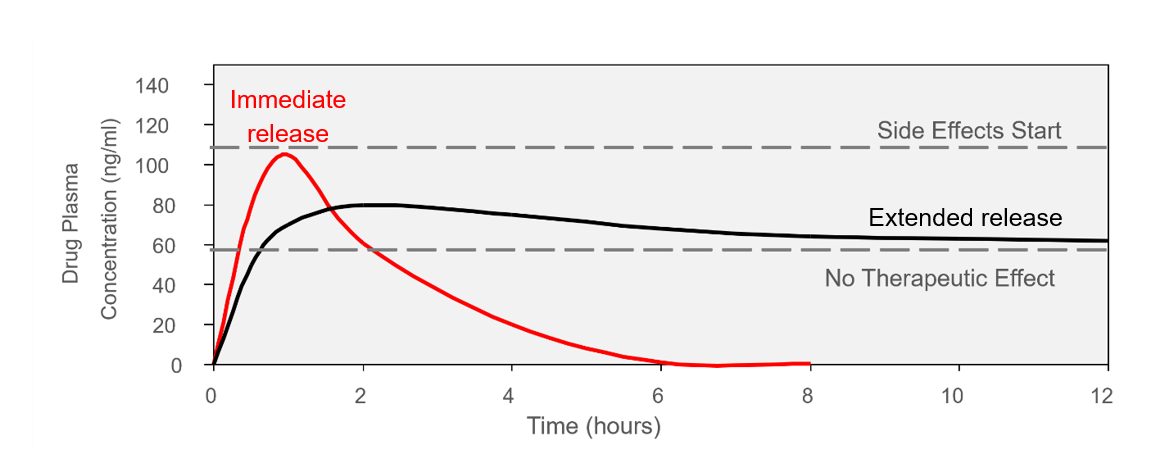
- It may reduce adverse side effects by limiting the intensity of the drug after the initial dose.
Extended Release vs. Controlled Release vs. Sustained Release
Controlled release (CR) and sustained release (SR) both fall under the broader category of extended release – also known as modified release. Controlled release involves medication that maintains a constant release of the drug over a period of time. Sustained release, on the other hand, releases drug at a predetermined rate to maintain a constant drug concentration for a specific period of time with minimum side effects.
SR medication is typically available in oral dosage forms, but CR medication can be administered into the body through other means besides oral dosage.
Delayed release (DR) is another form of modified release and these oral solid dosage forms are widely used to protect the gastric mucosa from irritating actives or to protect drugs sensitive to gastric fluids. For example, a drug meant to provide treatment to the small intestines would need to not release its active ingredient until it had reached this part of the body. They are designed for use on tablets or multiparticulate solid oral dosage products, including proton pump inhibitor (PPI) applications and enteric coated aspirin, which is widely taken.
|
|
Extended Release (ER, XR, XL) |
Sustained Release (SR) |
Controlled Release (CR) |
Delayed Release (DR, EC) |
|
Definition |
An umbrella term for formulations that release the drug over an extended period. |
Releases a drug gradually over time, aiming to prolong the action and reduce dosing frequency. |
Releases the drug at a nearly constant rate (zero-order kinetics) to maintain steady drug levels. |
Releases the drug at a time other than promptly after administration, usually at a specific location in the GI tract. |
|
Goal |
Reduce dosing frequency and maintain drug effect over a longer period. |
To maintain therapeutic drug levels and avoid frequent dosing. |
To precisely control and maintain drug concentration within the therapeutic window, avoiding both toxicity and sub-therapeutic levels. |
Often used to protect the stomach from irritation or prevent the drug from being degraded by acidic condition of stomach. |
|
Mechanism |
Achieved through a variety of technologies that slow absorption. |
Uses specific technologies (e.g., matrices, coatings) to slow the dissolution and absorption. |
Uses advanced mechanisms to deliver the drug at a constant rate. |
Typically uses an enteric coating that is resistant to stomach acid (low pH) but dissolves in the higher pH environment of the small intestine. |
Extended Release
Controlled release (CR) and sustained release (SR) both fall under the broader category of extended release – also known as modified release. Controlled release involves medication that maintains a constant release of the drug over a period. Sustained release, on the other hand, releases drug at a predetermined rate to maintain a constant drug concentration for a specific period with minimum side effects. SR medication is typically available in oral dosage forms, but CR medication can be administered into the body through other means besides oral dosage.
Delayed Release
Delayed release (DR) technology is commonly utilised in oral solid dosage forms to safeguard the gastric mucosa from potentially irritating active pharmaceutical ingredients, or to shield drugs that are unstable in gastric fluids or to deliver the drug at specific site in gastrointestinal tract. Examples of drug that are administered by delayed release technology are proton pump inhibitor (PPI), Aspirin, Sulfasalazine, etc delivered either in tablets or multiparticulate solid oral dosage forms.
Types of Extended-Release Mechanisms
Key mechanisms for achieving extended release are:
Diffusion-Controlled Systems
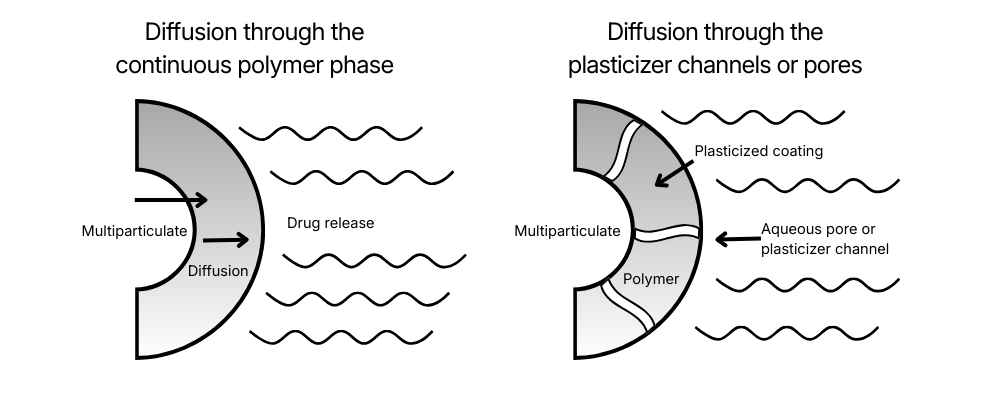
The drug release rate is governed by its diffusion through an insoluble polymer barrier or a gel layer that is formed due to hydration of polymer in matrix dosage form. In reservoir devices, the drug is coated with a polymer membrane, and the drug diffuses through this membrane at a controlled rate. Polymer film has molecular sized opening between crossed-linked polymeric chains, and drug diffuses through these opening which is known as HINDERED MOLECULAR DIFFUSION as depicted in the images. In matrix devices, the drug is uniformly dispersed within a polymer matrix, as the polymer hydrates it forms a gel layer through which the drug diffuses out.
Dissolution-Controlled Systems
Dissolution-controlled drug release is a mechanism where the rate of drug release is governed by the speed at which a drug or its polymeric carrier material dissolves in the surrounding gastrointestinal fluid.
The gastrointestinal fluid penetrates the coating, dissolves the drug, and the dissolved drug then diffuses out through the coating or the coating gradually dissolves over time. The thickness and dissolution rate of the polymer layer determine how fast the drug will be released.
Osmotic Release Systems
In osmotic drug delivery technology, a drug is release through a controlled process that uses osmotic pressure to achieve a steady, continuous delivery of medication, largely independent of the gastrointestinal tract's pH or motility. These systems consist of a core containing the drug and an osmotic agent, surrounded by a semipermeable membrane with a small delivery orifice. Water enters through the membrane, creating pressure that forces the drug out of the orifice as depicted in the image. Learn more about osmotic systems here.
.png?width=1118&height=447&name=Diffusion%20%20diagrams%20(1).png)
Erosion and Biodegradation Systems
Drug release through erosion and biodegradation systems is a controlled release mechanism where a drug is released as a polymer matrix degrades, either by surface erosion, which provides steady and predictable release or bulk erosion, which is less consistent or via biodegradation, which uses natural processes like hydrolysis, and factors such as polymer type and matrix erosion rate affect the release profile.
The process involves fluid penetration, drug dissolution, and transport from the matrix as the polymer breaks down, a mechanism often modeled by combining diffusion and erosion kinetics. Factors like polymer type, drug properties, and matrix erosion rate dictate the drug release profile.
Swelling-Controlled Systems
Drug release though swelling-controlled system involves hydration of water-absorbent, polymer network such as a hydrogel when in contact with water or gastrointestinal fluid causing infiltration of polymer structure, resulting in swelling that relaxes the polymer chains and generates sufficient space for the encapsulated drug to be liberated. The release rate is governed by the swelling kinetics of the polymer and the diffusion characteristics of the drug molecules within the swollen matrix.
Ion-Exchange Systems
This technology involves complexation of drug with an insoluble ion-exchange resin via electrostatic interactions or through a reversible process where the drug is displaced from the resin by ions present in the body's fluids (e.g., sodium, chloride), a mechanism that allows for controlled release. Factors like pH, ionic strength, and the resin's physical properties influence the release rate, making it useful for applications like oral, nasal, and ophthalmic delivery to control dosage and reduce toxicity.
Challenges for Extended Release Tablet Formulation
We spoke with Don Loveday, Colorcon’s Global Business Manager, about the challenges pharmaceutical companies face in developing ER tablets and the best practices they employ to overcome them. He identified four primary challenges: getting the release profile right, ensuring formulation is consistent and reliable, matching innovator products, and acquiring the necessary technical expertise.
Challenge #1: The Importance of Release Profiles
One of the primary challenges in ER formulation is achieving the desired release profile. "It’s the main challenge for controlled release or any kind of extended release from a high level,” Loveday says.
Release profiles are critical because they determine how the drug is released over time in the body. Manufacturers aim for either zero-order (constant release) or first-order (gradual decrease in release rate) profiles, depending on the specific drug and therapeutic goals.
Best Practice: Utilize Pre-formulated Systems
To address this challenge, Tran suggests leveraging pre-formulated systems. “We want to get more and more of our customers to start going toward our formulated systems,” she says. “The benefit there is that we've already created an optimized formulation that's consistent and will deliver those types of controlled release profiles on a consistent basis."
By using pre-formulated systems, pharmaceutical companies can benefit from proven formulations that consistently achieve desired release profiles. This approach can save time and resources in development while ensuring greater reliability in the final product.
Challenge #2: Consistency and Reliability in Formulation
Ensuring consistency in the formulation process is another big challenge. Inconsistencies in the formulation can lead to variations in drug release, potentially affecting the drug's efficacy and safety.
"Our products definitely provide solutions to consistency and reliability because they're formulated systems,” Loveday says.
Best Practice: Implement Mixing/Blending Processes
To address this challenge, companies should focus on implementing robust mixing and blending processes. Loveday emphasizes the importance of uniformity in the blend: by using high-quality formulated systems and paying careful attention to the mixing and blending stages, manufacturers can ensure greater consistency in their final products.
This may involve investing in advanced mixing equipment, developing standardized procedures, and implementing rigorous quality control measures throughout the production process – or working with a company like Colorcon that already has these capabilities.
Challenge #3: Matching Innovator Products
Generic drug manufacturers face an additional challenge: achieving bioequivalence with the innovator product while developing a unique formulation. This requires a lot of expertise and resources.
“We have generic companies that are trying to formulate and copy innovators,” Loveday says. “They’re really trying to make sure they match exactly what innovators are doing. And that's where we would come in.”
Best Practice: Partner with Experienced Formulation Experts
To overcome this challenge, generic manufacturers should consider partnering with experienced formulation experts. Companies like Colorcon can provide valuable assistance in this area.
These partnerships can offer access to specialized knowledge, advanced technologies, and proven formulation strategies that can help generic manufacturers achieve bioequivalence more efficiently. By using external expertise, generic companies can streamline their development process and increase their chances of successfully matching innovator products.
Challenge #4: Technical Expertise Gap
Not all companies have the in-house expertise to develop complex ER formulations. Loveday notes. “Sometimes there are challenges with just understanding what the technologies are for a zero-order release,” he says. “Customers just don't have that expertise. So sometimes that's the challenge as well: knowing where to find right people to direct those types of projects.”
This knowledge gap can significantly impact a company's ability to develop effective ER formulations.
Best Practice: Leverage External Expertise
To bridge the technical expertise gap, companies should take advantage of the knowledge and experience already available in the industry. As Loveday suggests, this is where companies like Colorcon can play a crucial role. By partnering with experts who have deep knowledge of various ER technologies, such as Matrices, Multiparticulate, OROS, companies can:
- Access specialized knowledge without the need for extensive in-house training
- Benefit from years of industry experience and best practices
- Stay up-to-date with the latest advancements in ER formulation technologies
- Receive guidance tailored to their specific product needs
Leveraging external expertise can significantly accelerate the development process and improve the chances of creating successful ER formulations, even for companies without extensive internal resources.
Regulatory and Quality Considerations for Extended-Release Formulation
Like any pharmaceutical product ER formulation must comply with strict regulatory and quality requirements. The following must be considered during development:
- Dissolution method development is a crucial part of product design. It is a systematic process to create a reliable test for evaluating drug release from the dosage form. Key steps include understanding the API properties, selecting appropriate apparatus and dissolution medium, optimizing parameters like agitation speed, and developing a validated analytical method for sample analysis. The goal is a reproducible method that ensures consistent product quality that can predict vivo performance.
- Establishing an In Vitro-In Vivo Correlation (IVIVC) is a systematic approach in developing a predictive mathematical model between an in vitro drug release profile (usually dissolution) and the in vivo pharmacokinetic (PK) response (plasma concentration or amount absorbed). This correlation is used to reduce the need for human bioavailability/bioequivalence studies, especially for post-approval changes and formulation optimization.
- Change control during scale-up and post-approval phases of ER drug products is usually done as per the guidance outlined in regulatory Scale-Up and Post-Approval Changes (SUPAC) guidance document. These guidelines, primarily established by the FDA, categorize changes based on their potential impact on the drug's quality, safety, and efficacy, and dictate the necessary documentation and reporting procedures.
Final Thoughts
Developing extended-release tablet formulations presents several challenges, from achieving desired release profiles to ensuring formulation consistency, matching innovator products, and overcoming technical expertise gaps.
By implementing best practices such as using pre-formulated systems, focusing on robust processes, and taking advantage of external expertise, pharmaceutical companies can deal with these challenges a lot more effectively.
The key to success in ER tablet formulation lies in recognizing when to seek external support. Whether you're a generic manufacturer looking to match an innovator product or a company exploring new ER technologies, contact Colorcon. Our expertise and formulated systems can support your ER solid oral development efforts, helping bring your innovative treatments to patients more efficiently.
Frequently Asked Questions
- What is the main difference between extended release and immediate release tablets?
Extended release (ER) tablets are designed to release a drug gradually over an extended period, providing a steady medication level in the body. Immediate release tablets deliver the drug all at once, resulting in a rapid increase in drug concentration.
- What are the key challenges in formulating extended-release tablets?
The key challenges in formulating extended-release tablets include achieving the desired drug release profile while maintaining consistency and reliability throughout the formulation process. Manufacturers must also ensure that generic versions closely match innovator products in terms of performance and quality, which can be technically demanding. Additionally, bridging gaps in technical expertise remains a significant hurdle, as developing robust extended-release systems requires specialised knowledge and experience.
- What types of polymers are commonly used in extended-release formulations?
Examples of polymers used in extended release formulations are Hydroxypropyl methylcellulose, Ethylcellulose and methacrylic acid. For osmotic formulations, the Corelease range of products can be used to simplify the manufacturing process.
- How do formulation parameters affect drug release profiles?
Formulation parameters—such as the choice of matrix system, mixing/blending processes, and the use of pre-formulated systems—directly impact the drug release profile. Achieving the correct release profile is crucial for therapeutic efficacy and safety. Robust processes and quality control help ensure consistency in drug release.
- What analytical methods are used to evaluate extended-release performance?
Dissolution method development and establishing in vitro-in vivo correlation (IVIVC) helps evaluate how the drug is released and absorbed, ensuring robustness to physiological variability and regulatory compliance.
- How can formulation best practices improve product robustness and regulatory success?
Formulation best practices strengthen product robustness by ensuring consistent drug release and uniformity through pre-formulated systems and robust mixing processes. Leveraging external expertise helps bridge technical gaps and keep pace with advancements, reducing risks during development. Together, these strategies improve reliability and compliance, supporting smoother regulatory approval.

.png)