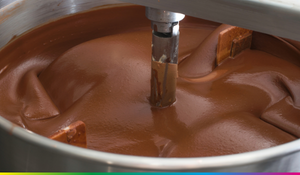
When it comes to creating food and confection design, understanding hydrophobic and hydrophilic ingredients is key. These behaviors determine how materials interact, how stable a product will be, and whether chocolate stays smooth or becomes unusable.
With the global chocolate market valued at $123.05 billion in 2024 and projected to reach $184.69 billion by 2033 (Grandview Research), this knowledge has never been more essential for anyone working with color systems, coatings, or fat‑based and water‑based matrices.
Key Takeaways
-
Hydrophobic and hydrophilic behaviors determine ingredient compatibility: Understanding whether materials are oil loving or water loving is essential for predicting stability, texture, and color performance in food and confectionery systems.
-
Water and chocolate are fundamentally incompatible: Chocolate is an oil continuous system, and even small amounts of water cause seizing, graininess, and processing challenges making aqueous dispersions unsuitable.
-
Oil dispersions excel in fat-based environments: Oil dispersions integrate smoothly into lipid systems such as chocolate, fillings, and high fat baked goods, delivering consistent viscosity and uniform color.
-
Aqueous dispersions are ideal for water-based applications: Hydrophilic materials disperse predictably in gummies, beverages, panned confections, and icings.
-
Colorcon supports both system types with technical guidance and benchtop trials to help teams choose the right dispersion.
Hydrophobic vs. Hydrophilic: The Core Difference
Hydrophobic materials repel water and blend easily with fats, oils, and other nonpolar ingredients like cocoa butter and lipid-soluble pigments. Hydrophilic materials attract and dissolve in water. Sugars, starches, gums, and water-soluble colors disperse well in aqueous systems but are incompatible with fat-continuous environments. These behaviors influence everything from texture to color performance. In short:
- Hydrophobic = oil loving, water repelling
- Hydrophilic = water loving, oil repelling
Why You Can’t Use Water in Chocolate
Chocolate is an oil-continuous system. Even a small amount of water dissolves surface sugar and forms a sticky syrup that causes particles to clump, leading to chocolate “seizing.” Once seized, chocolate becomes thick, grainy, difficult to process, and it cannot be restored to its original smooth, fluid state through heating, tempering, or any other method. Once it seizes, the only solution is to discard it and start again. Because aqueous dispersions contain water, they disrupt chocolate’s structure. This causes issues such as loss of flowability, grainy texture, uneven color and challenges during tempering and molding. Oil-based dispersions are the only compatible option.
Where Oil Dispersions Excel
Oil dispersions, like Opatint® Liquid Color Concentrate, integrate smoothly into lipid‑continuous systems, maintaining viscosity and allowing color to distribute evenly. Their hydrophobic nature ensures consistent, high‑quality color performance. They are ideal for:
- Chocolate and compound coatings
- Fat‑based fillings (pralines, nut butters, ganaches)
- Decorative chocolate work
- High‑fat baked goods
- Lipid‑continuous confectionery coatings
Where Aqueous Dispersions Are the Better Choice
.png?width=450&height=300&name=Candies%20(1).png) Aqueous dispersions are designed for water-based systems. Products such as Opacolor® Liquid Coloring System disperse easily and deliver bright, uniform color. They are commonly used in:
Aqueous dispersions are designed for water-based systems. Products such as Opacolor® Liquid Coloring System disperse easily and deliver bright, uniform color. They are commonly used in:
- Hard‑panned and soft‑panned confections
- Gummies and jellies
- Marshmallows
- Beverages and syrups
- Icings, glazes, and frostings
- Extruded snacks
- Sugar‑based coatings
In these environments, hydrophilic materials behave predictably and remain stable.
Choosing the Right Dispersion with Colorcon’s Technical Support
Fat-based systems need oil dispersions, while water-based systems depend on aqueous dispersions. Matching the dispersion to your product’s chemistry improves consistency, appearance, and processing efficiency. Colorcon offers both oil dispersible and aqueous dispersible color solutions to support color systems, coatings, or fat‑based and water‑based matrices. Colorcon’s technical guidance and benchtop trials make it easy to evaluate color options directly in your application, effectively extending your R&D capabilities. Whether you are formulating chocolate, confections, or beverages, our expertise ensures stable, vibrant, and reliable color performance that helps your product look as good as it tastes!
Frequently Asked Questions
- Why can’t I use water-based colors in chocolate?
Chocolate is an oil continuous system. Water dissolves surface sugars and causes particle clumping, leading to seizing, grainy texture, and poor flow. Only oil dispersions are compatible.
- What is the difference between hydrophobic and hydrophilic ingredients?
Hydrophobic ingredients repel water and blend with fats and oils, while hydrophilic ingredients attract and dissolve in water. This determines how they behave in different food matrices.
- When should I choose an oil dispersion?
Oil dispersions are best for fat-based systems such as chocolate, compound coatings, nut butters, ganaches, and other lipid continuous applications.
- When are aqueous dispersions the better option?
Aqueous dispersions work well in water-based systems like gummies, beverages, panned confections, icings, and sugar-based coatings, where hydrophilic materials disperse easily.
- How can Colorcon help me select the right dispersion?
Colorcon offers hands-on technical support and quick benchtop evaluations to assess color performance directly in your formulation, working as an extension of your R&D team. If you’re unsure whether your product behaves more like an oil‑based or water‑based system, your Colorcon representative can help determine compatibility and guide you to the most suitable dispersion.


.png)