When it comes to drug manufacturing, the right film coating for tablets is essential for any pharmaceutical company. This technologically advanced process has evolved over time and differs depending on the type of drug formulation.
But why is film coating so important, and what do drug manufacturers need to know about it? This guide will help you understand some key factors when it comes to the film coating process, and how to choose a film coating that makes the most sense.
Key Takeaways
- Film coating is essential for tablet performance and patient experience, offering protection against environmental factors, improving swallowability, and masking unpleasant tastes.
- Material selection matters—polymers, plasticizers, and pigments determine coating strength, drug release behavior, and overall product quality.
- Film-coated tablets deliver multiple advantages over uncoated tablets, including enhanced stability, branding opportunities, and controlled release for better therapeutic outcomes.
- The coating process requires precision across five steps: tablet preparation, coating solution preparation, equipment setup, coating application, and cooling/discharge.
- Ready-to-use systems like Opadry® simplify operations, reducing preparation time and ensuring consistent, high-quality coatings tailored to specific drug and project needs.
Materials & Ingredients Commonly Used in Film Coating
Typical Film-Forming Polymers
Polymers are the backbone of tablet coatings, providing mechanical strength and functional properties. Common examples include:
- Hypromellose (HPMC): A widely used cellulose derivative offering excellent film strength and compatibility with aqueous systems. It is ideal for immediate-release coatings and can also serve as a rate-controlling polymer in extended-release formulations.
- Ethylcellulose (EC): A hydrophobic polymer often used in controlled-release coatings due to its ability to form moisture-resistant films.
- Other options: Hydroxypropyl cellulose (HPC) for flexibility and adhesion, and polyvinyl alcohol (PVA) for superior properties in aqueous systems. These polymers differ in glass transition temperature and solubility, influencing coating performance and processing conditions.
Plasticizers
Plasticizers are added to improve film flexibility and reduce brittleness by lowering the polymer’s glass transition temperature. Examples include:
- Polyethylene Glycol (PEG): Commonly used for water-soluble systems.
- Triethyl Citrate: Effective in enteric and controlled-release coatings.
These additives prevent cracking during coating and storage, ensuring smooth application.
Colorants, opacifiers, and pigments serve both functional and aesthetic roles:
- Branding: Colors help differentiate products and enhance patient compliance.
- Light Protection: Pigments like titanium dioxide shield sensitive APIs from light degradation.
- Opacity: Improves tablet appearance and masks core imperfections. These components are critical for maintaining drug stability and reinforcing brand identity.
Benefits of Film Coating Tablets
Film coating tablets presents multiple benefits, from protecting the tablet core during manufacturing and storage, to its ultimate consumption by the patient.
Manufacturing and Storage
Many active pharmaceutical ingredients (APIs) are sensitive to elements such as light, oxidation, and moisture. Wrapping the tablet in a film coating can protect the API from these external forces, ensuring that the drug will continue to work as intended even after it has been stored for a considerable amount of time.
Drug Release Patterns
Film coatings allow drug manufacturers to control the release of the API in terms of site, rate, and time. This is important for a variety of drugs that require a delayed release, or for drugs that must release a consistent amount of the API over a specified period.
Patient Compliance
Orally taken tablets are the best way to ensure patient compliance, because they are the least invasive way to administer the drug and it is also less expensive to both the manufacturer and patient. Film coating the tablet aids compliance by making it easier for the patient to consume it.
Film Coated vs. Uncoated Pills
We’re often asked “do we really need to film coat tablets?” Arguably, the most crucial reason to coat tablets is to ensure differentiation to minimize medication errors.
The table below summarizes the difference between uncoated and coated tablets.
|
Feature |
Uncoated Tablet |
Film Coated Tablet |
|
Surface appearance |
Matte surface, often with visible powder |
Smooth, uniform, colored or glossy due to film coating |
|
Taste and odor masking |
Bitter taste and foul odor of the active ingredient are more noticeable |
Film coating helps mask unpleasant tastes and odors |
|
Ease of swallowing |
Often harder to swallow, especially for larger tablets |
Easier to swallow due to smooth surface. |
|
Protection from moisture & light |
Can require expensive packaging to protect the tablet from moisture, light, and air |
Film coating provides a protective barrier that improves stability |
|
Mechanical strength |
More prone to abrasion, chipping, or dusting |
Reduced chipping, dusting, and surface damage |
|
Patient compliance |
Lower for bitter, large, or visually unappealing tablets |
Typically, higher due to appearance and swallowability |
|
Manufacturing complexity |
Simpler and faster manufacturing process |
Requires additional film coating step and specialized equipment |
|
Cost considerations |
Lower cost with fewer processing steps |
Higher cost due to coating and equipment but total cost of ownership is reduced in time |
|
Branding & identification |
Limited visual differentiation. No brand identity and greater risk of medication errors. |
Easier to create a stronger brand and differentiation using color and finish |
What Is the Difference Between Enteric Coated (Delayed Release) and Immediate Release Film Coated Tablets?
Delayed release or enteric coated tablets are widely used to protect the gastric mucosa from irritating actives or to protect drugs sensitive to gastric fluids. Unlike immediate release film coated tablets, enteric coated tablets won't dissolve in the acid of the stomach but will dissolve in the basic pH environment of the small intestine. Film coatings, on the other hand, are meant to dissolve upon swallowing and release the drug within a short period.
|
Feature |
Immediate Release Film-Coated Tablets |
Enteric-Coated Tablets |
|
Primary purpose |
Could be one or more of the following:
|
Protect drug or stomach from gastric acid |
|
Typical Polymers |
HPMC, PVA |
PVAP-P, Ethyl cellulose, Eudragit |
|
Drug release location |
Stomach |
Small intestine |
|
Effect on release timing |
Immediate release |
Delayed release |
|
Acid resistance |
Minimal |
High (resists stomach acid) |
|
Typical benefits |
Taste masking, easier swallowing, improved stability, easy identification |
Reduced stomach irritation, protection of acid-sensitive drugs. Added benefits are improved appearance and stability, taste masking and easier swallowing. |
|
Common applications |
Majority of OTC and prescription tablets |
NSAIDs, acid-sensitive or GI-targeted drugs |
5 Step Film Coating Process
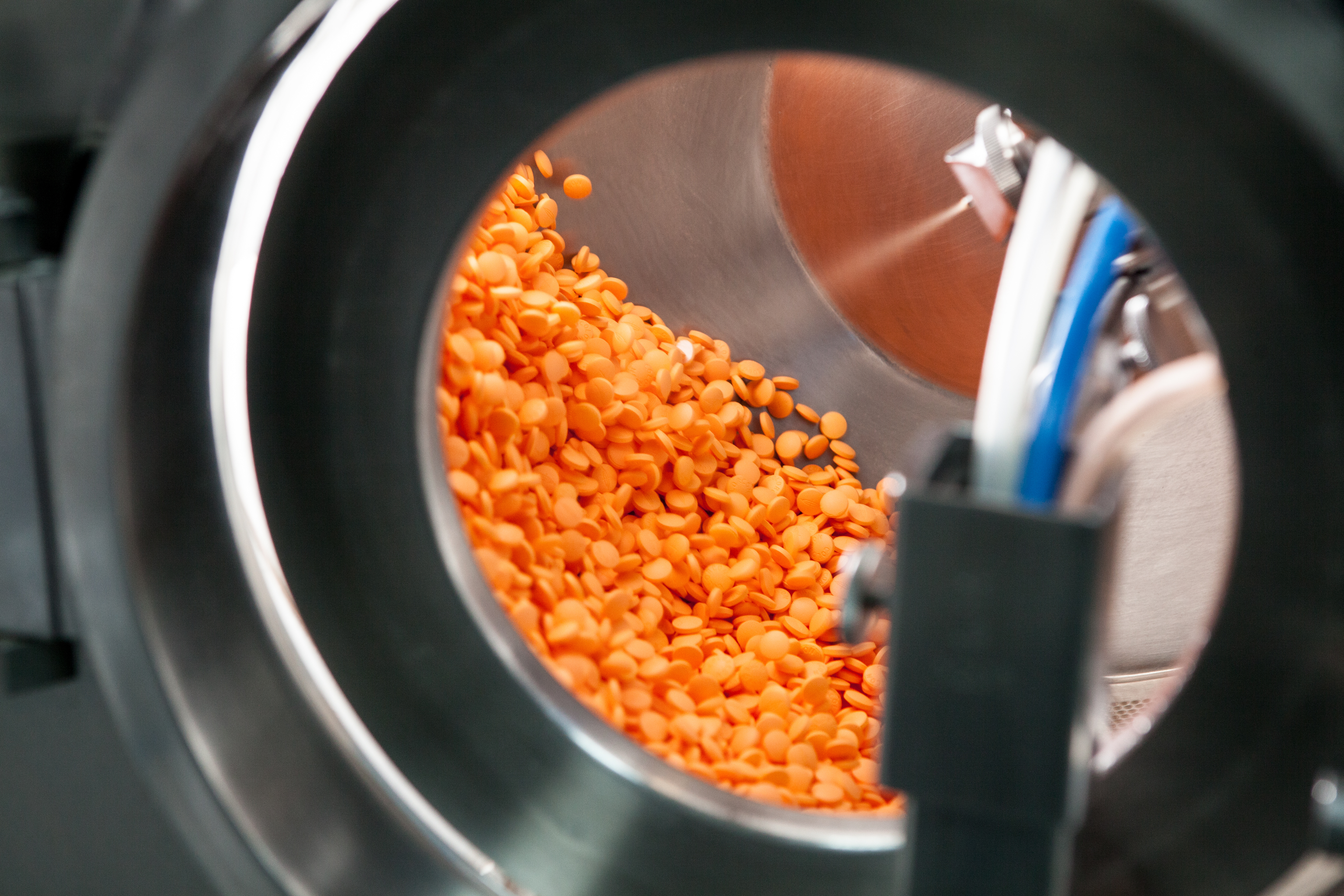
Tablets are coated using a process that involves spraying a thin polymer film on the surface of the tablet core. The tablet coating solution – which is formulated with specific ingredients like pigments, polymers, and plasticizer – is sprayed onto the rotating tablet bed and the solvent (typically water) is evaporated from the surface using hot air. This leaves a thin film on the surface of the tablet core.
There is ongoing innovation to continue to advance ways to improve efficiency through coating formulation and process design. The equipment used and processes may vary from company to company, and from drug to drug.
To ensure the perfect film coating process the following steps should be optimized correctly:
 Tablet Core Preparation
The selection of tablet shape and core composition is critical to ensure tablets can withstand the mechanical stress, heat, and moisture encountered during the coating process. Core ingredients should be chosen carefully, considering the physical and chemical properties of the active pharmaceutical ingredient (API).
Certain excipients, such as magnesium stearate, may negatively impact coating adhesion due to their hydrophobic nature. Similarly, high levels of superdisintegrants can lead to surface erosion because of their sensitivity to moisture. To streamline formulation development, Colorcon recommends using HyperStart® C2C, a digital formulation service that provides tailored recommendations based on API characteristics and specific project requirements.
The importance of Tablet Robustness and Shape
Tablet hardness and friability are critical indicators of whether a tablet can withstand the mechanical stresses of the coating process. Hardness typically correlates with tablet weight—larger tablets require greater strength to prevent breakage or lamination during coating. Recommended hardness values are:
- ~250 mg: 8–10 kp
- ~500 mg: 10–14 kp
- ~750 mg: 15–20 kp
- ~1000 mg: 20+ kp
(1 kp ≈ 9.8 N)
For optimal performance, friability should be less than 0.1%, ensuring tablets resist chipping and surface erosion throughout processing.
In addition, tablet edges should be well-rounded and free of sharp points to minimize erosion and prevent sticking during manufacture. For guidance on tooling design, consult Colorcon or your tooling supplier.
 Preparation of the Coating
Before the coating can be applied, all ingredients must be completely dispersed into the solvent. If ingredients are not dispersed correctly the atomizing gun may become blocked or speckles may be seen on the surface of the tablet. A short video guide is available here.
The importance of the Correct Equipment
To ensure complete dispersion the following equipment is necessary:
- Variable-speed mixer capable of creating and maintaining a vortex
- Propeller stirrer (diameter about ¼–⅓ of the mixing vessel diameter)
- Mixing vessel sized to hold 15–25% more than the total suspension volume
 Equipment Set-up
- Check Pan Type and Size: Fully or partially perforated pans affect airflow and temperature settings. Confirm the pan matches your batch size and coating requirements.
- Inspect Air Handling System: Ensure inlet and exhaust ducts are clean and unobstructed to maintain proper airflow and drying efficiency.
- Verify Spray Zone and Baffles: Confirm spray guns are correctly positioned and baffles (if present) are secure for uniform coating.
The importance of Configuring Process Parameters
- Pan Speed: Adjust based on tablet size and pan design to ensure proper mixing without breakage.
- Airflow and Temperature: Fully perforated pans typically require higher airflow and lower temperatures; partially perforated pans need the opposite.
- Spray Rate: Match spray rate to solids content and drying capacity to avoid overwetting.
 Coating
- Load tablets into the coating pan.
- Start pre-warming with controlled airflow and temperature to remove surface moisture and bring tablets to target temperature.
- Begin spraying the coating dispersion as fine, uniform droplets onto the moving bed of tablets.
- Maintain balance between spray rate, inlet air temperature, and airflow to avoid overwetting or spray drying.
Mixing and Drying
- Continuous mixing ensures even distribution of coating.
- Heated, conditioned air evaporates solvent while preventing tablet sticking or erosion.
- Adjust parameters dynamically to maintain steady-state conditions.
- As solvent evaporates, polymers coalesce to form a smooth, continuous film.
- Monitor appearance and weight gain to confirm coating uniformity.
 Cooling/discharge
- After achieving the target weight gain and appearance, stop spraying.
- Cool tablets gradually to ambient temperature before discharge.
The Best Tablet Coating Solutions
The ideal film coating solution will depend on the nature of the drug and the goal you are trying to achieve.
The Opadry® Complete Film Coating System
Pharmaceutical companies have a reliable choice for film coating solutions: Colorcon’s Opadry. This customized, one-step system combines polymer, plasticizer, and pigment in a dry concentrate, delivering an elegant, high-quality finish across a wide range of tablet cores.
As regulatory requirements grow more complex, Colorcon’s extensive expertise ensures you receive coating formulations tailored to your specific needs. For over 60 years, we’ve partnered with pharmaceutical, nutritional, and animal health companies worldwide, helping brands select the right film coating for their products.
Ready to find the perfect solution? Contact us today for a consultation or learn more about Opadry.
Frequently Asked Questions
- What is film coating and why is it used in pharmaceutical tablets?
A film coating is a thin uniform layer applied to pharmaceutical tablets. There are many reasons for coating tablets including but not limited to: branding, identification, stability, controlled release and improving swallowability.
- What materials are typically used to create a film coating?
A film coating contains an immediate release or rate controlling polymer, plasticizer/s and pigments. Learn more here.
- How are film-coated tablets manufactured?
A thin film is applied to tablet cores using a coating machine. Tablets are tumbled and sprayed with the solution using an atomizing gun.
- Does film coating affect how quickly a tablet dissolves or is absorbed?
Yes, the polymer within the film coating controls the rate of dissolution and ultimately. where the drug is absorbed in the body.
- What common defects occur in film-coated tablets and what causes them?
Common defects are peeling, edge erosion and breakage. Defects can be caused by various factors and usually corrected by making changes to the core formulation, tablet shape or coating process. If you are experiencing defects contact Colorcon for technical support or refer to our handy troubleshooting guide.
- Are film-coated tablets safe to cut, crush, or split?
It is not recommended to cut film coated tablets unless a medical professional advises it. If the coating is a coated with a controlled or delayed release coating it may result in the medication not working correctly.

.png)