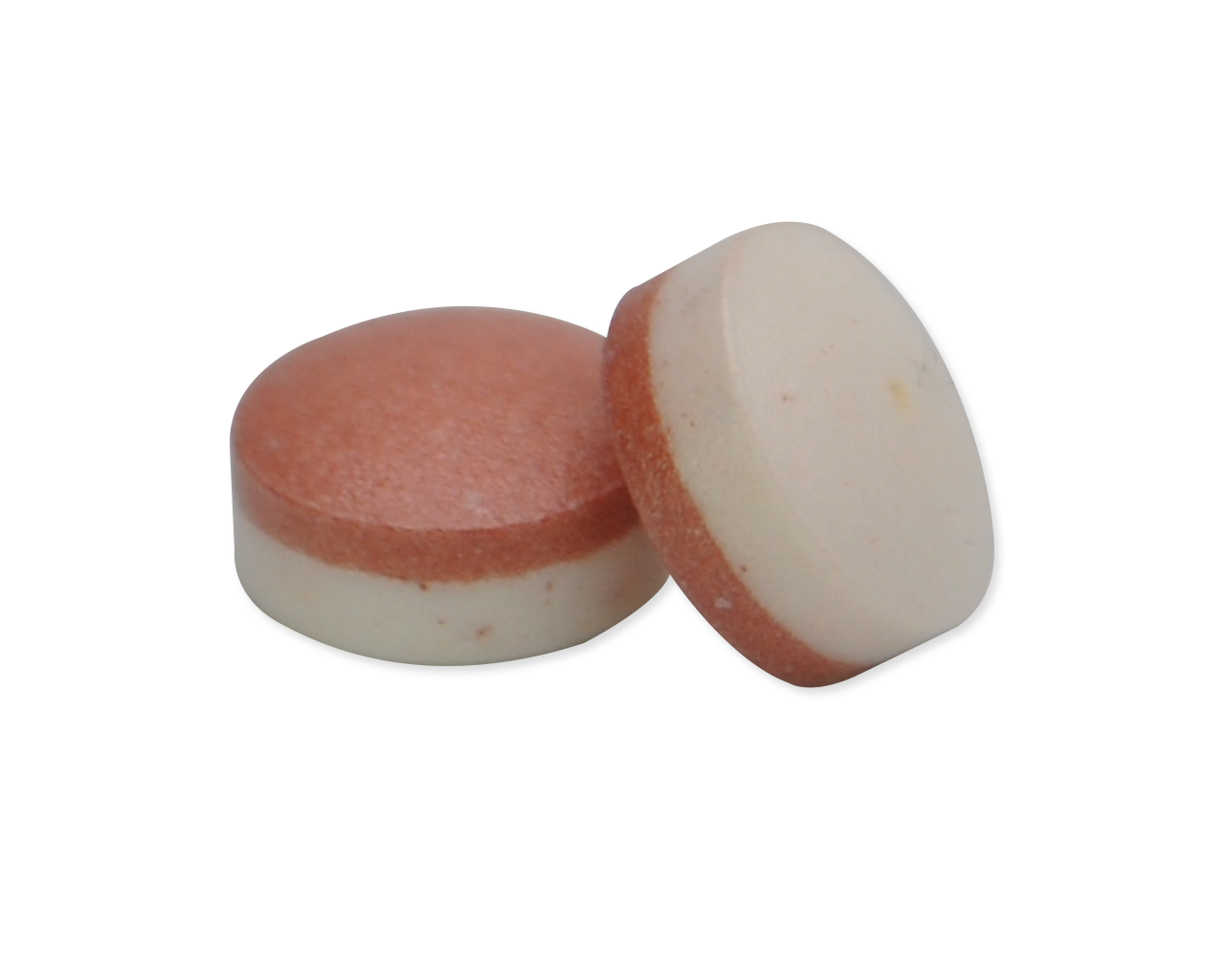
Push-Pull Osmotic Pump (PPOP) tablets are a type of controlled-release drug delivery system. For a refresher check out our previous blog on Push-Pull Osmotic Pump (PPOP) Dosage Forms – An Overview. This article will cover steps that can be taken to simplify manufacture of PPOP dosage forms.
Steps in the Manufacturing Process of a PPOP Tablet
Step 1: Preparation of core tablets
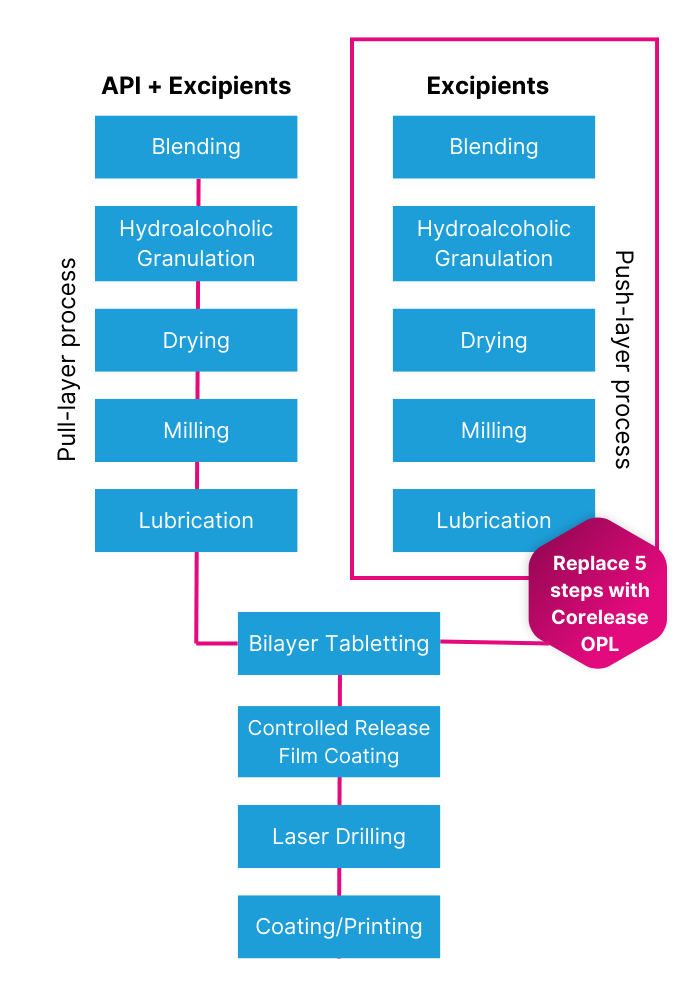
The first-choice manufacturing method is direct compression, which involves compressing the powdered ingredients into tablets in one single step. If the flow and compression of the active is poor, then granulation could be used. Firstly, the drug layer is compressed, followed by the push layer, forming a dual-layered tablet.
Step 2: Coating with semipermeable membrane
The compressed bilayer tablets are typically coated using a conventional coating pan with a cellulose acetate dissolved in a volatile solvent (usually acetone with a small quantity of water). Coating thickness is optimized to control the water permeability.
Step 3: Drilling of the delivery orifice
A precise laser drilling system creates a small hole (typically 0.4–0.8 mm) on the drug side allowing the drug to release through the orifice via osmotic pressure.
Step 4: Drying and packaging
The coated tablets are dried to remove residual solvents and packaged in moisture-resistant blister packs or bottles.
Simplifying the Manufacturing Process
As manufacturing costs continue to rise, manufacturers face increasing pressure to streamline their processes. One of the most effective ways to simplify production is by using fully formulated systems.
Corelease OPL™, a direct-to-hopper push layer blend eliminates multiple manufacturing steps and the associated cleaning processes. By adopting this one-step solution, quality control testing is required for just a single ingredient rather than multiple raw materials, significantly reducing complexity and improving efficiency.
 Further time can be saved by applying a fully formulated coating system. Again, reducing the number of raw materials and manufacturing steps. Corelease CA™, is the first one-step semipermeable membrane designed to ensure consistent release from osmotic tablets.
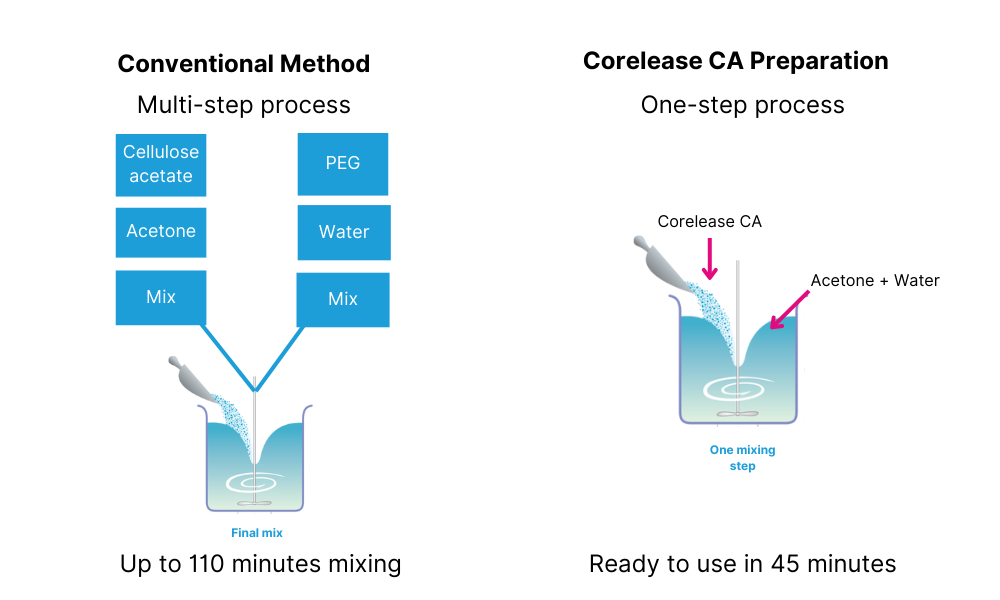
Incorporating cellulose acetate as the water insoluble component and polyethylene glycol (PEG) as pore-former, Corelease CA is dissolved directly in a co-solvent mixture, providing fast and easy preparation of the coating solution. By optimizing the levels of the key components, and accounting for critical material attributes, the permeability of the film is controlled, providing consistent drug release from a push-pull osmotic pump (PPOP) tablet.
Final Thoughts
By partnering with Colorcon, pharmaceutical companies can harness our expertise, cutting-edge technologies and exceptional support to create high-performance products. Our global network of technical experts and formulation laboratories is dedicated to supporting every phase of your formulation design process. Fast track your journey towards improved pharmaceutical performance with Corelease.

Frequently Asked Questions
-
What is a push-pull osmotic pump (PPOP) tablet?
A push-pull osmotic pump tablet is an oral controlled-release dosage form designed to release medicine at a consistent rate over time. It typically contains a drug layer, a push layer, a semipermeable membrane and a small delivery orifice that allows the drug to be released through osmotic pressure.
-
How does a PPOP tablet provide controlled drug release?
PPOP tablets use osmosis to control drug release. Water enters through the semipermeable membrane, causing the push layer to swell and gently push the drug out through the laser-drilled orifice. This mechanism helps deliver a steady release profile that is less affected by food, gastric pH or gastrointestinal conditions.
-
Why are PPOP dosage forms considered complex to manufacture?
PPOP dosage forms can be more complex than conventional tablets because they require a bilayer tablet core, a carefully controlled semipermeable membrane and a precisely drilled delivery orifice. Each step must be controlled to support consistent tablet performance and reliable drug release. -
How can fully formulated systems simplify osmotic tablet manufacturing?
Fully formulated systems can help reduce the number of raw materials, manufacturing steps and cleaning processes required. For example, a direct-to-hopper push layer blend and a one-step semipermeable membrane coating system can make PPOP manufacturing easier to manage while supporting consistent controlled-release performance.
-
What role does the semipermeable membrane play in a push-pull osmotic pump tablet?
The semipermeable membrane controls how much water enters the tablet. By adjusting membrane composition and coating thickness, formulators can influence water permeability and help achieve the desired drug release profile from the osmotic pump tablet.

.png)