.png)
Original article published in Nutraceutical Business Review - June 2026.
Probiotic stability is a constant balancing act between product performance, process efficiency, cost and compliance. It is therefore important to understand how blending, compression, powder flow and packaging can support probiotic stability, culture viability and shelf life
If you work in formulation or manufacturing, you know that probiotic products can be some of the most challenging supplements to develop and scale. You are not just building a tablet, capsule or powder that meets a specification. You are trying to protect living organisms while ensuring colony-forming unit (CFU) label claims are met at the end of expiry. That makes probiotic stability a constant balancing act between product performance, process efficiency, cost and compliance. It is therefore important to understand how blending, compression, powder flow and packaging can support probiotic stability, culture viability and shelf life.
Top Five Stability Challenges in Probiotic Formulation and Manufacturing
 Sensitivity to Environmental Conditions
One of the biggest frustrations with probiotics is how quickly viability can be lost when environmental conditions are not tightly controlled. Moisture, heat, oxygen and light all work against stability, whether it’s during ingredient handling, processing or storage. For formulation scientists, this means building a system that protects sensitive strains without compromising performance. For manufacturing teams, it means managing exposure during production and preventing variability from one batch to the next. Oxygen-sensitive strains (i.e. Anaerobic bacteria) such as Bifidobacterium add another layer of complexity because even short-term exposure can affect survival.
To address this, stability needs to be designed in from the start through careful ingredient selection and characterisation. Some organisms are naturally more tolerant of heat, oxygen and moisture than others, and choosing strains with stronger processing resilience can reduce downstream risk, simplify scale-up and lessen the burden on the rest of the formulation and packaging system. Spore-forming probiotics such as Bacillus species can also offer improved stability compared with more traditional lactic acid bacteria because they are better able to withstand harsh environmental conditions.
 Manufacturing Stress
 The manufacturing process can be where a promising probiotic formulation starts to lose performance. Compression forces, shear during blending, transfer steps and drying conditions can all damage cells before the product ever reaches the pack. Scientists often have to work within narrow process windows, where small changes in force, dwell time, temperature or humidity can affect CFU recovery. This can make scale-up challenging, as conditions that worked at bench or pilot scale do not always translate cleanly into routine production.
The solution is to build robust, protective processes around the organism. Drying technologies such as freeze-drying can preserve cell structure and viability by removing moisture under low temperatures, while optimised spray drying can provide a more cost-effective large-scale alternative when paired with protective carriers. Adding cryoprotectants or stabilisers such as trehalose during drying can help protect cell membranes and proteins, and tightly controlled manufacturing conditions with low humidity and temperature can potentially reduce premature degradation throughout processing.
 Ingredient Interactions
Formulation scientists must determine excipient compatibility and ingredient interactions that are not always obvious early in development. High water activity materials can tigger metabolic activity and rapid death, minerals or actives may create an unfavourable microenvironment, and some functional ingredient can undermine probiotic survival over time. The challenge is not simply choosing ingredients that process well—it is selecting a formulation system that protects viability while still delivering the intended product profile. This is where formulation optimisation becomes critical. Using low-moisture, low water activity excipients, adjusting the pH microenvironment and screening ingredient compatibility early can all help reduce stability risks.
Microencapsulation can provide an additional layer of protection by surrounding probiotic cells with polymers, lipids or polysaccharides to shield them from moisture, oxygen and other destabilising influences during processing and storage, while also supporting survival through the gastrointestinal tract.
 Shelf Life and Supply Chain Conditions
Temperature fluctuations during transportation or improper storage conditions in retail environments can lead to significant CFU decline. If refrigeration is required, it can limit market accessibility and increase logistical costs. Controlled storage and transport conditions remain important, but the industry is increasingly moving towards shelf-stable formulations that reduce dependence on cold chain logistics and improve convenience for both manufacturers and consumers.
Humidity is also a major pathway to degradation. Protective packaging also plays a central role and should be considered early in the development process. High-barrier blister packs with aluminium foil, HDPE bottles with desiccants and oxygen scavengers, and unit-dose formats can all help minimise exposure to moisture and oxygen throughout shelf life.
 Regulatory and label claims
Manufacturers must ensure that the labelled CFU count is met at the end of shelf life, not just at the time of manufacture. This often requires overages, which increase formulation costs and variability. Demonstrating stability through robust testing is essential for compliance and consumer trust. A practical response is to combine carefully modelled overages with strong accelerated and real-time stability programs so degradation rates are better understood, and formulations can be optimised with greater confidence. As predictive modelling tools improve, manufacturers are gaining better ways to estimate shelf life, reduce excessive overages and support more reliable label claim compliance.
A Case Study Demonstrating Improved Stability
In a recent case study, Colorcon demonstrates how combining Nutracore® label friendly excipients with molecular sieve desiccants and controlled-atmosphere packaging improved the viability of Lactobacillus acidophilus under a range of storage conditions. The aim was to evaluate whether these label friendly excipients, used alongside different desiccant and packaging configurations, could better preserve probiotic viability.
Study Design
The study evaluated a probiotic capsule formulation containing Lactobacillus acidophilus (200B CFU/g) using two excipient systems: one based on Nutracore® Filler and Nutracore® Lubricant, and a conventional comparator based on MCC and Mg St. These formulations were packed in multiple bottle configurations, including HDPE and a Nutra active container system, with no desiccant, silica gel or molecular sieve desiccants at different loadings.
Samples were stored at 25°C/60% RH, 30°C/65% RH and 40°C/75% RH for three months. Viability was measured after three months using AFU (Active Fluorescent Units), alongside water activity and loss on drying.
Nutracore-based Formulations Showed Better Probiotic Survival
Across all storage conditions, the Nutracore-based formulation consistently maintained higher probiotic viability than the MCC-Mg St formulation. This difference became especially clear as storage conditions became more challenging.
At 25°C/60% RH, the Nutracore-based formulation delivered higher viability after three months across all packaging configurations than the MCC-Mg St comparator. The strongest results were seen in the Nutra active container system, where viability increased from 7900 to 8260 million cells/g, while the comparable MCC-Mg St system reached only 3610 million cells/g. Even in standard HDPE bottles with molecular sieve desiccants, the Nutracore formulation maintained substantially better viability than the conventional excipient system.
At 30°C/65% RH, the performance gap widened further. The MCC-Mg St formulation showed significant viability loss across every packaging setup, ranging from 598 to 3830 million cells/g after three months, while the Nutracore-based system retained markedly stronger survival, with results ranging from 2080 to 8520 million cells/g. Again, the Nutra active container system delivered the best protection, followed by smaller packs and higher molecular sieve loading.
The most striking results were seen under accelerated conditions at 40°C/75% RH. Under these harsher conditions, most packaging setups showed a drop in probiotic viability, particularly for the conventional MCC-Mg St system. However, the Nutracore-based formulation in the Nutra active container system retained 8350 million cells/g after three months, compared with 3940 million cells/g for the MCC-Mg St formulation in the same packaging configuration. These findings show that the right combination of excipient system and packaging can protect probiotic viability even under extreme storage stress.
Why Moisture Management Matters
The results suggest that the improved performance of the Nutracore-based formulation is closely linked to its moisture-management properties. Compared with the MCC-Mg St formulation, the Nutracore system showed lower water activity at baseline and after storage, helping to create a more protective environment for moisture-sensitive probiotic cells.
Figure 1. LoD and water activity of Nutracore Filler compared to other filler excipients
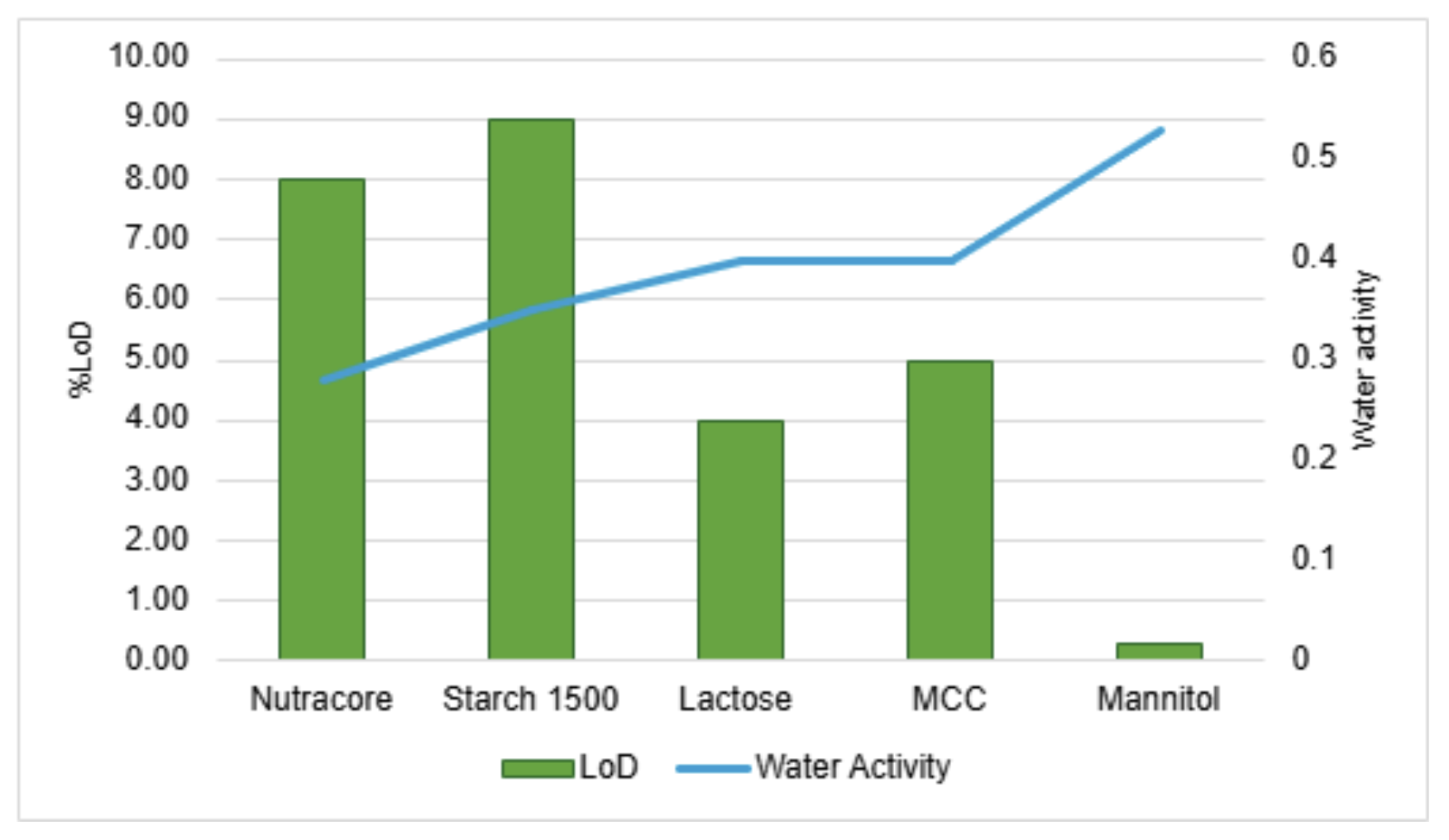
This distinction matters because water activity, rather than moisture content alone, is a critical factor in probiotic stability. The case study showed that the Nutracore formulation maintained significantly lower water activity than the MCC-Mg St comparator, despite differences in total moisture content, supporting better protection against moisture-induced degradation (figure 1).
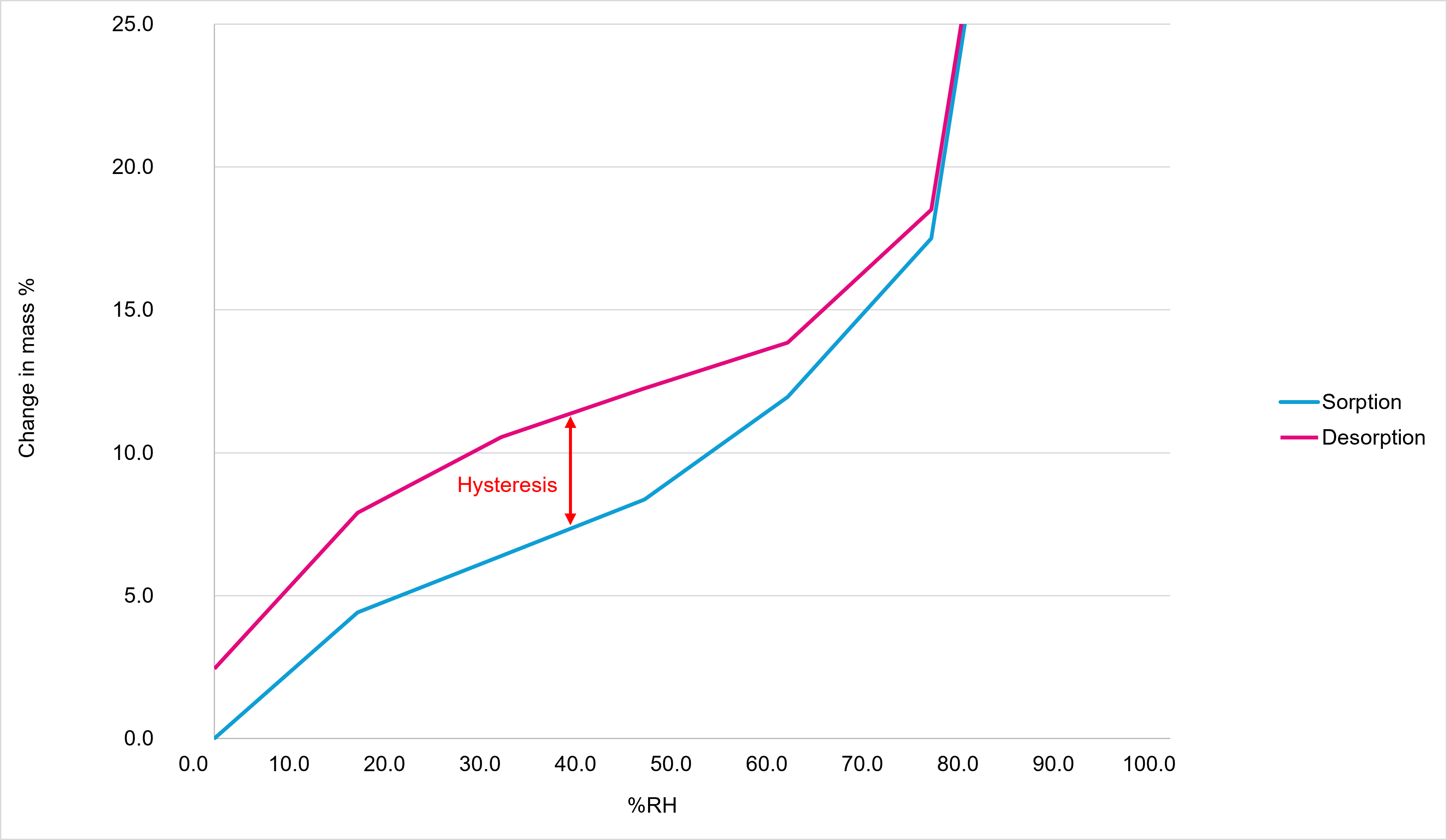
The study also showed that Nutracore Filler has moisture scavenging behaviour, as seen in its dynamic vapour sorption profile. It was able to absorb moisture and not fully release it during desorption, demonstrating hysteresis (figure 2). This suggests that it can help bind headspace moisture and reduce the likelihood of moisture interacting with the active ingredient.
Figure 2. DVS Isotherm of Nutracore Filler depicting hysteresis
Packaging and Desiccants Further Improved Outcomes
Although excipient choice had a major impact, packaging strategy also played a significant role. Across both formulation types, adding desiccant improved viability, and molecular sieve desiccants generally outperformed silica gel. Higher desiccant loading also delivered better protection in many cases.
The best overall results came from combining the Nutracore-based formulation with molecular sieve desiccants and an optimised container-closure system. Across both formulations, molecular sieve desiccants reduced water activity and loss on drying more effectively than no desiccant, while the Nutra active container system delivered the strongest moisture control overall.
This reinforces an important point for nutraceutical manufacturers: probiotic stability is rarely solved by formulation alone. It requires a system-level approach that considers the interaction between excipients, packaging materials, desiccant type, pack size and closure design.
Additional Processing Benefits
In addition to supporting stability, Nutracore Filler and Nutracore Lubricant also provided strong functional performance during processing. The study reported excellent flow, compressibility and lubrication, indicating that these excipients can support both manufacturing efficiency and product protection.
This is a valuable advantage for formulators looking to simplify development. Rather than choosing between processability and stability support, the right excipient system may help deliver both.
Closing Thoughts
This case study shows that formulation and packaging decisions can have a major impact on probiotic viability and shelf life. Compared with a conventional MCC-Mg St formulation, the Nutracore-based system maintained higher viability, lower water activity and stronger overall protection throughout the three-month study, particularly when paired with molecular sieve desiccants and effective moisture-control packaging.
For nutraceutical manufacturers, the findings highlight the value of a more integrated approach to stability. Selecting excipients that actively support moisture management and pairing them with appropriate packaging can help manufacturers meet label claims more confidently, reduce the need for overages, support longer shelf life under real-world conditions, and improve product robustness across different markets and climates.